
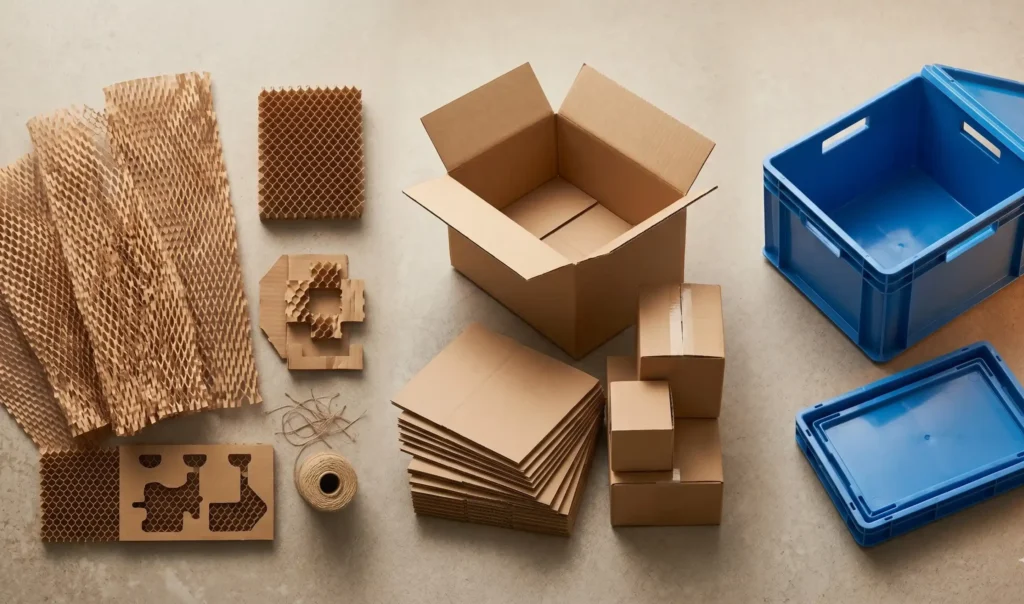
The transition from traditional containment methods to engineered packaging systems represents a significant evolution in global supply chain management.
In the contemporary logistics landscape, performing a detailed honeycomb packaging comparison is no longer a peripheral procurement decision but a core strategic imperative.
Selecting the right medium influences transportation efficiency, product safety, and environmental compliance.
This report provides an exhaustive technical analysis of honeycomb boxes, regular corrugated cardboard, and synthetic polymers.
We utilize data-driven insights to delineate their performance across a spectrum of industrial stressors and economic cycles.
Understanding the Three Core Packaging Materials
The mechanical performance of any packaging substrate is dictated by its core geometry.
The distinction between honeycomb, corrugated, and plastic systems is rooted in how these materials distribute internal and external forces.
Honeycomb Boards: Structure and Advantages
Honeycomb paperboard is characterized by its core of interconnected hexagonal cells bonded between two flat liner sheets.
One of the most significant engineering advantages found in this honeycomb packaging comparison is its quasi-isotropic behavior.
Unlike corrugated structures, honeycomb distributes compressive loads across cell walls in every lateral direction simultaneously.
Regular Corrugated Cardboard: Strengths and Limitations
The architecture of corrugated cardboard relies on parallel fluted waves.
While standard boxes provide excellent column strength parallel to the flutes, they are inherently anisotropic.
This means their mechanical properties vary significantly depending on the orientation of the applied force.
Plastic Packaging (Foam/EPS): Traditional Use Cases
Synthetic polymers introduced a paradigm of reusability and environmental resilience.
Materials like HDPE exhibit high strength-to-density ratios and maintain their geometry under diverse mechanical stresses.
However, they often carry a much higher carbon footprint compared to renewable paper-based solutions.
Structural Integrity and Protection Metrics
An evaluation of load-bearing capacity reveals stark differences in how these materials behave under pressure.
Load-Bearing Capacity: Static vs. Dynamic Limits
Laboratory results indicate that honeycomb structures typically support 3 to 4 times more vertical compression force than corrugated cardboard.
Honeycomb resists long-term creep, which is a common failure mode for bulky goods boxes in long-term storage environments.
Shock Absorption: Honeycomb Core vs. Foam Cushions
The ability to absorb kinetic energy is vital for protecting fragile contents.
Impact resistance testing shows that honeycomb paperboard absorbs approximately 60% more shock energy than standard corrugated board.
The systematic deformation of the hexagonal cells dissipates energy across a wide surface area.
Sustainability: Carbon Footprint and End-of-Life
Modern sustainability strategies require an objective understanding of the resource impact of packaging materials.
Recyclability and Waste Reduction
Honeycomb packaging is 100% recyclable in standard paper streams and can be repulped into new products in as little as 14 days.
This supports a closed-loop system that reduces the demand for virgin timber.
For businesses aligning with APCO sustainability targets, this is a decisive advantage.
Material Lifespan in Industrial Loops
While cardboard boxes are generally discarded after a single use, honeycomb totes and plastic containers are designed for multiple cycles.
A honeycomb packaging comparison regarding reusability shows that paper-based honeycomb excels in carbon sequestration metrics compared to petroleum-linked plastics.
Cost Analysis and Operational Efficiency
A comprehensive economic analysis must consider the total cost of packaging, including freight and labor.
Total Cost of Ownership (TCO) Model
On a pure unit-cost basis, corrugated cardboard is the most affordable.
However, when accounting for assembly labor and transport density, the TCO for heavy-duty pallet boxes often favors honeycomb or reusable plastic over time.
Honeycomb is typically 15% to 25% more expensive than corrugated board but reduces damage rates by up to 60%.
Technical Risks and B2B Compliance
High Humidity and Sea Freight Performance
As hygroscopic materials, both honeycomb and corrugated cardboard are susceptible to moisture.
However, honeycomb retains its structural properties up to 40% longer than corrugated alternatives in high humidity.
This makes it more resilient for international sea freight.
Anti-Static (ESD) Protection for Electronics
For the electronics sector, specialized honeycomb inserts can be treated with anti-static or ESD-protective coatings.
This ensures that sensitive components meet strict ISO safety standards without generating harmful static charges.
Conclusion: Strategic Material Selection
Our honeycomb packaging comparison proves that honeycomb paperboard is the superior choice for industrial applications requiring high vertical strength and shock absorption.
It provides a definitive solution to the weight burdens of timber and the environmental impact of plastics.
To find the best solution for your business, get a quote today or visit our online shop.
Frequently Asked Questions
What are the key differences between honeycomb packaging and regular corrugated cardboard?
The primary difference is the core structure.
Honeycomb board uses a dense, hexagonal cell design that provides superior compression strength and impact absorption compared to the fluted paper in standard corrugated cardboard.
Is honeycomb packaging generally cheaper or more expensive than polystyrene foam?
While the cost per unit varies, honeycomb packaging is often cheaper overall.
The tooling required for custom cutting is significantly less expensive than the molds used for polystyrene, and it lowers freight costs by reducing shipping weight.
How does using honeycomb packaging help a business meet sustainability goals?
Honeycomb packaging is made from renewable and recycled paper fibers, making it fully recyclable in standard paper streams.
This reduces plastic waste and lowers carbon footprints compared to petroleum-based alternatives.
Can honeycomb pallets support the same weight as traditional wooden pallets?
Yes, heavy-duty honeycomb pallets can support static loads of up to 2,000 kg.
They are often preferred for their strength-to-weight ratio and exemption from ISPM 15 international heat-treatment regulations.
Is honeycomb packaging suitable for use in automated e-commerce packing systems?
Yes, honeycomb materials integrate easily into automated lines.
Their standardized formats and flat-packing design help businesses with high shipping volumes maintain maximum operational efficiency.
What happens to honeycomb board when exposed to high humidity during sea freight?
Above 70% Relative Humidity, the material’s structural integrity can be compromised.
Businesses should specify a moisture-resistant coating on the outer liner to mitigate this risk for international sea shipments.
What products are best suited for honeycomb packaging over other materials?
Honeycomb is ideal for fragile, heavy, or awkwardly shaped items.
This includes ceramics, mirrors, machinery components, furniture, and high-value electronics that require superior shock protection.
Can honeycomb board offer anti-static protection for electronics?
Yes, while the core is paper-based, suppliers can apply specialized anti-static or ESD-protective coatings to the facing sheets.
This makes the packaging safe for shipping sensitive electronic components.