
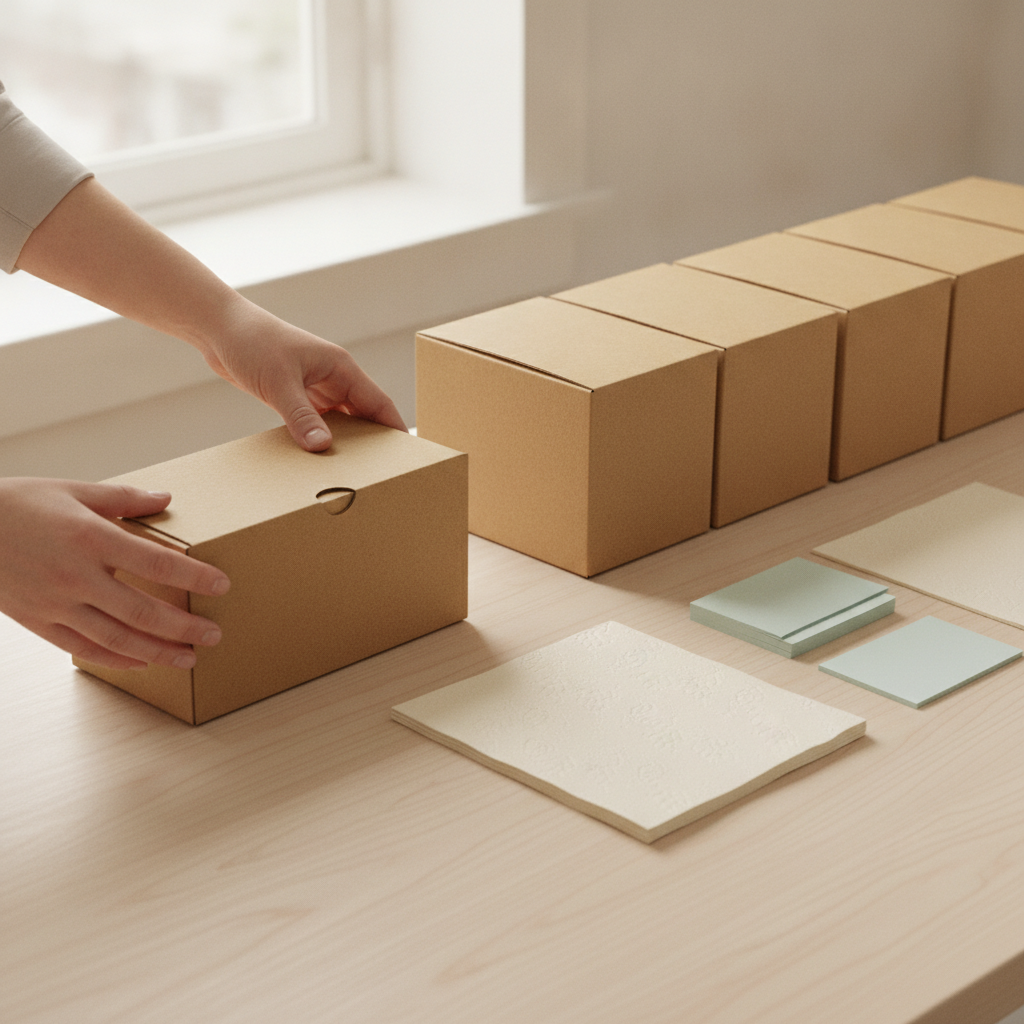
The short answer for most Australian subscription businesses: a roll end tuck front (RETF) mailer box, sized in millimetres to sit inside your postage band, printed full colour, ordered from a local manufacturer with no minimum order so you can test before you scale. This guide unpacks each of those choices: styles, a metric size chart, what the packaging really costs, how to physically pack boxes at volume, and how local ordering compares with offshore. If you want to see options first, our subscription box packaging is made in Sydney to any size.
Key takeaways
- The RETF mailer is the standard subscription format: tape-free, reclosable, flat-stored and printable inside and out.
- Size the box to the postage band, in millimetres: a box even 10 mm too tall can push every single shipment into a dearer tier.
- Unit price falls sharply between 50 and 1,000 units, but postage is usually the bigger ongoing cost.
- With no minimum order you can prototype a handful of boxes before committing a monthly cycle to one design.
What subscription box packaging has to do
A subscription box has four jobs, and the fourth is the one most founders miss. It has to protect the contents through the courier network every single month, and it has to present well, because for a subscriber the box is the product experience arriving on repeat. A clean reclose matters too, since many subscribers keep or reuse the box. The fourth job is fitting its postage band: a subscription business pays the freight bill monthly, forever, so a sizing mistake is not a one-off cost, it compounds with every renewal. Every choice below (style, size, print, board) should be checked against those four jobs.
Choosing your box style: why RETF mailers win
Roll end tuck front (RETF) mailers
The RETF is the subscription standard for good reasons. It locks closed without tape, so packing is faster and the customer opens it without scissors. The front tuck recloses properly, which matters for a box people revisit. It ships and stores flat until you need it, and the one-piece die cut prints edge to edge inside and out. Nearly every recognisable subscription brand ships in some variant of this custom mailer box format.
When a carton or folding carton fits better
If your box is unusually heavy (bottles, jars, pantry goods above a few kilograms), a taped shipping carton in a heavier board grade protects better and costs less per cubic centimetre. If you ship one small lightweight product, a folding carton inside a satchel can beat a full mailer on both weight and cost. Style follows contents; the RETF is the default, not a law.
Subscription box sizes for Australia (in millimetres)
Every size chart on the internet seems to be written in inches for the US market. Australian boxes are ordered in millimetres, and the difference between internal and external dimensions causes most wrong-size orders: internal is what your products must fit; external is what the courier measures.
Common sizes in millimetres
| Size | Internal (mm) | External approx. (mm) | Typically fits |
|---|---|---|---|
| Compact | 220 x 160 x 80 | 226 x 166 x 86 | Accessories, beauty minis, socks, cards |
| Standard | 280 x 200 x 95 | 286 x 206 x 101 | Most monthly lifestyle and snack boxes |
| Large | 310 x 240 x 110 | 316 x 246 x 116 | Apparel plus extras, multi-product boxes |
| Deep | 305 x 220 x 150 | 311 x 226 x 156 | Pantry, candles, jars with void fill |
These are starting points, not rules. Because every box we make is custom sized, the smartest move is to lay your actual products out, measure the footprint with 10 to 15 mm of clearance, and order to that.
Matching your box to AusPost and courier bands
Australian carriers price by satchel tier and by cubic weight (length x width x height in metres x 250 kg per cubic metre, billed against actual weight, whichever is greater; the current tiers and satchel sizes are listed on Australia Post’s parcel sending pages). Two practical consequences. First, a compact or standard box that seats inside a prepaid satchel face, such as the 355 x 225 mm small or 390 x 270 mm medium satchel formats, can ride flat-rate satchel pricing while still giving board protection. Second, the 10 mm rule: when your external height sits just under a tier boundary, resist adding “a little more room”. A box 10 mm taller can move every shipment up a band, and at 100 subscribers that surcharge lands monthly, forever. Check your external dimensions against your carrier’s current tiers before you sign off the die-line, because carrier pricing changes more often than box designs do.
Printing and branding that survives shipping
Full-colour outside print carries the brand to the doorstep; inside print is the subscription trick, because the open-lid moment is photographed and shared more than the outside ever is. Kraft board with a bold one-colour inside print is a proven budget-friendly look, and full-colour printing steps in when the brand needs it. Two cautions from the packing bench: heavy lamination and large foil areas can break kerbside recyclability, and intricate finishes slow assembly. A useful habit is printing disposal guidance on the box itself, ideally with the Australasian Recycling Label, so subscribers know the box goes in the kerbside bin.
What subscription box packaging costs
Most suppliers hide pricing behind quote forms, so here is how the number is actually built. Your per-box packaging cost is the box itself plus the insert card, tissue or void fill, and any sticker or seal. The box is the biggest line, and its price moves on four drivers: size, board grade, print coverage and quantity. As an indicative picture for a standard-size custom-printed mailer:
| Run size | Indicative per-unit range (AUD) | What you are paying for |
|---|---|---|
| 50 units | Roughly $1.50 to $3+ | Short-run premium; the cheapest way to test a real design |
| 250 units | Roughly $1.20 to $2.50 | Setup cost spread out; the usual first “proper” run |
| 1,000 units | Often under $1.50 | Volume pricing; per-unit well below the short-run rate |
Treat these as ranges, not quotes: a large deep box in heavy board with full-coverage print sits above them, a compact kraft box below. Then keep perspective: for most subscription businesses postage is the bigger ongoing cost, which is why the sizing section above matters more than saving ten cents on board. Get a quote with your exact dimensions and quantities and you will have real numbers within 24 hours.
How to pack a subscription box, step by step
Design advice is everywhere; the physical pack-out is covered nowhere, so here it is from the manufacturing side.
- Store flat, fold in batches. Keep boxes as flat stacks and fold 30 to 50 at a time before a pack run rather than one by one per order. RETF mailers fold in seconds without tape.
- Set an assembly line, not a per-box ritual. Line the products up in packing order: base layer or crinkle fill first, hero product centred, supporting products around it, insert card on top, tissue last if you use it.
- Pack to a checklist. One laminated card listing the month’s contents prevents the most expensive subscription mistake: the missing item and the replacement shipment that follows it.
- Weigh before you book. Weigh a finished box, check it against your postage band, and only then generate the month’s labels in a batch.
- Batch your dispatch. Sealing, labelling and lodging in one run beats trickling orders out, and carriers handle a single manifest better than fifty ad-hoc lodgements.
A realistic bench rate with a folded-ahead stack and a checklist is roughly a box per minute for a simple fill. If your current pack-out is much slower, the box design (taped closures, awkward void fill, oversized formats) is usually the culprit rather than the packer.
Ordering in Australia: local vs offshore
| Local Sydney manufacture | Offshore import | |
|---|---|---|
| Lead time | Days to a couple of weeks | Commonly 4 to 8 weeks with sea freight |
| Minimum order | None, test runs from a handful of boxes | Frequently 500 to 1,000 units |
| Prototype first | Yes, order one, hold it, adjust | Rarely practical |
| Reorders and tweaks | Fast, iterate between cycles | New container, new wait |
| Freight surprises | Local delivery | Customs, port delays, currency swings |
A subscription business ships on a billing cycle, and a late container means a missed month you cannot invoice. That is the real risk hiding inside a cheaper offshore unit price. Our boxes are manufactured at Gregory Hills in South West Sydney with no minimum order, which means the sensible path is available to everyone: prototype one box, ship a 50-unit test month, then scale the run once the design has survived contact with real couriers and real subscribers.