
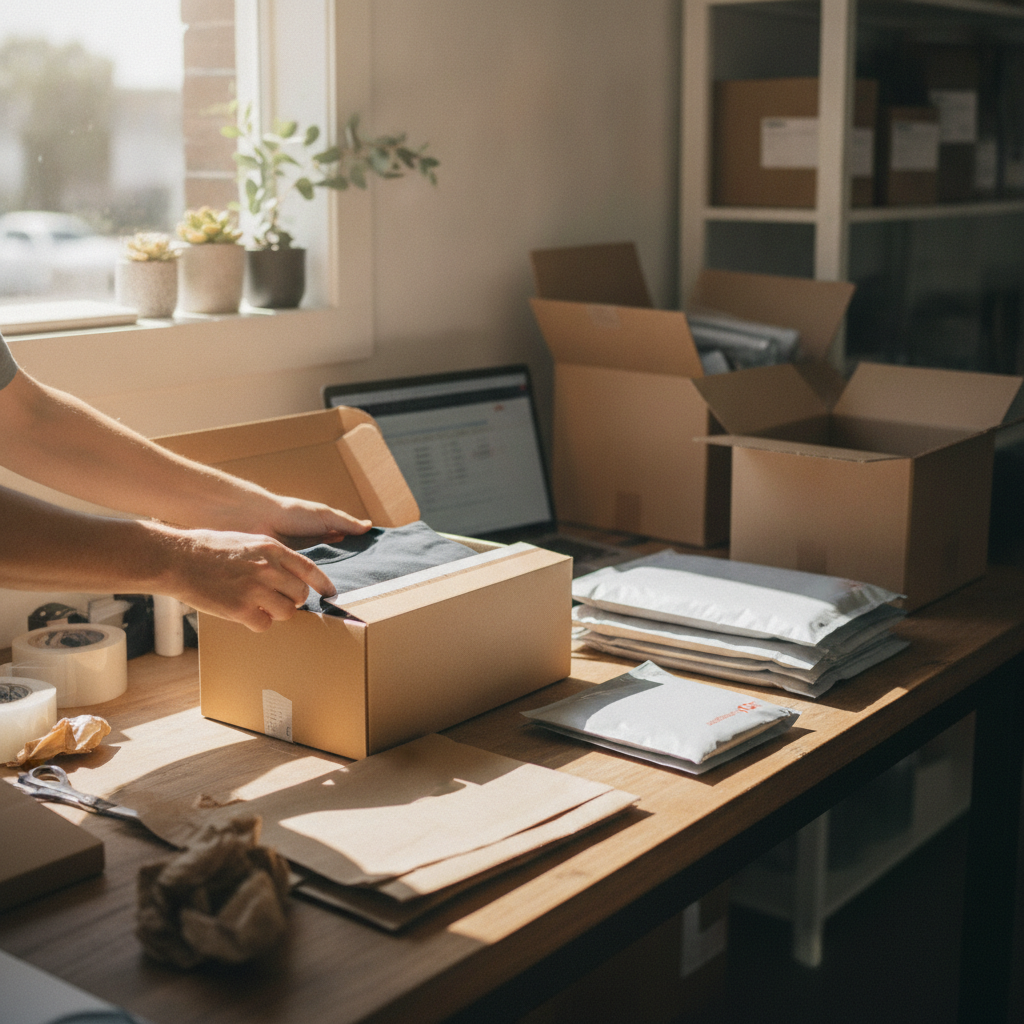
eCommerce packaging is the box, mailer or satchel your product travels in from your pack bench to your customer’s door. It has three jobs: protect the product through the courier network, carry your brand into the customer’s hands, and keep your shipping costs under control. This guide covers the main packaging types, how to size them for Australia Post and couriers, what custom packaging really costs in Australia, and how to keep it sustainable. If you already know what you need, our custom ecommerce packaging range is made in Sydney with no minimum order.
Key takeaways
- Match the format to the product: satchels for soft goods, mailer boxes for branded orders, shipping cartons for heavy or fragile items.
- Australian carriers charge by actual weight or cubic weight, whichever is greater, so an oversized box full of air inflates every single order.
- Custom-printed mailer boxes typically run from around $1.20 to $2.80 per unit at small quantities, and drop sharply past 250 units.
- With a no-minimum-order manufacturer you can test 50 branded boxes before committing to a full run.
What is eCommerce packaging?
eCommerce packaging is packaging built for the courier network rather than the retail shelf. A shelf box is designed to stand upright under store lighting and sell the product beside its competitors. An ecommerce box is designed to survive conveyor belts, van stacking and doorstep drops, open cleanly on a kitchen bench, and photograph well when your customer shares the unboxing. Transit damage is one of the leading causes of ecommerce returns, so the board grade and internal fit matter as much as the print. When those two are wrong, every damaged order costs you the product, the freight both ways and often the customer, which is why this guide spends so much time on sizing and board choice before it ever talks about branding.
The main types of eCommerce packaging
Most Australian online stores run on four formats, and many use two or three of them across their range.
Mailer boxes (die cut)
The ecommerce workhorse. A custom mailer box is die cut from corrugated board and folds together without tape, with a lid that opens like a gift rather than a carton. It suits subscription orders, apparel, cosmetics and anything where presentation matters. Print inside and out, and it doubles as your best marketing asset.
Shipping boxes (RSC cartons)
The regular slotted carton has four flaps top and bottom sealed with tape. It is the right format for larger, heavier or bulk orders where capacity beats presentation: homewares, multi-item orders, wholesale shipments. Single wall handles most loads under about 15 kg; double wall covers the rest.
Pick pack boxes
A pick pack box is self-locking and assembles in seconds without tape, which is exactly what you want when someone at a bench is packing dozens or hundreds of orders a day. Warehouses and 3PLs use them because the per-order pack time drops noticeably at volume.
Satchels and padded mailers
Soft packaging wins when the product is flat, flexible and hard to damage: t-shirts, accessories, soft homewares. Satchels are the lightest and cheapest format to ship, but they offer no crush protection, so anything rigid or fragile belongs in board. For flat items like art prints, shipping them rigid between board layers inside a mailer beats rolling them into tubes for most stores.
Satchel, mailer box or shipping box? How to choose
Pick the format by weight, fragility and how much the unboxing moment matters, not by habit. As a quick rule: fashion ships in satchels or mailers, subscription and gift orders ship in mailer boxes, and anything fragile or heavy ships in a corrugated carton.
| Product type | Typical weight | Fragility | Presentation need | Best format |
|---|---|---|---|---|
| Apparel, soft goods | Under 1 kg | Low | Medium | Satchel or mailer box |
| Cosmetics, skincare | Under 1 kg | Medium | High | Mailer box |
| Subscription or gift orders | 1-3 kg | Medium | High | Mailer box |
| Homewares, ceramics | 1-5 kg | High | Medium | Shipping box, double wall |
| Food and pantry | 1-10 kg | Medium | Medium | Shipping box or pick pack |
| Electronics, devices | 1-5 kg | High | Medium | Shipping box with inserts |
When one product could go either way, cost the two options properly, including the damage rate. A satchel that saves 60 cents but doubles breakages is not saving anything.
Sizing your packaging for Australia Post and couriers
Australian carriers bill you on actual weight or cubic weight, whichever is greater; the current formula and satchel tiers are on Australia Post’s parcel sending pages. Cubic weight is calculated as length x width x height in metres multiplied by 250 kg per cubic metre. A 40 x 30 x 20 cm box works out at 0.024 cubic metres, which the carrier treats as 6 kg even if the parcel weighs 1.5 kg. That is the whole case for right-sizing in one example: every centimetre of shipped air is billed like product.
Three practical sizing rules:
- Leave 2 to 3 cm of clearance around the product for protection, and no more.
- Fit boxes to satchel tiers where you can. A mailer box a few centimetres smaller than the satchel face on both sides, around 22 x 16 x 7 cm for a small prepaid satchel, gives you board protection at flat satchel pricing.
- Standardise on 2 or 3 sizes that cover your range instead of one oversized box for everything. Fewer sizes also means simpler storage and faster packing.
Because every box we make is custom sized, you can specify internal dimensions to the millimetre instead of rounding up to the nearest stock carton.
What does eCommerce packaging cost in Australia?
Custom-printed mailer boxes in Australia typically land between $1.20 and $2.80 per unit at small quantities, with plain unprinted equivalents well under that, and per-unit prices drop sharply once a run passes about 250 units. Four things drive the number: box size, board grade, print coverage and quantity. Size and quantity dominate, which is why right-sizing and consolidating onto fewer box formats usually saves more than shaving the print spec.
The part most guides skip is small-run economics. Imported packaging usually starts at minimums of 500 units or more, which forces a new store to gamble thousands of dollars on an untested size and design. A no-minimum-order manufacturer removes that gamble: order 50 branded mailers, ship real orders in them for a month, fix what annoyed you, then scale the run. We have written a full guide on no minimum order packaging for small businesses if you are starting from scratch, or get a quote with your exact dimensions and quantity and you will have real numbers within 24 hours.
Branding and the unboxing experience
Outside print carries the brand to the doorstep and into the delivery photo, while the customer meets your inside print at the moment they are most engaged, lid open on the kitchen bench. You do not need both on day one. A kraft box with a one-colour inside print often outperforms a full-colour wrap for a fraction of the cost, and tissue paper plus a thank-you card add more perceived care than extra ink. Keep the design simple enough that it does not slow your packing bench, because a beautiful box that takes ninety seconds to assemble becomes a real cost at scale.
Sustainable packaging Australian shoppers expect
Sustainability claims in Australia need substance behind them. Plain kraft corrugated board is kerbside recyclable nationwide, which already puts it ahead of padded plastic mailers and mixed-material laminates that contaminate the recycling stream. Look for FSC-certified board, and use the Australasian Recycling Label (ARL) so customers know exactly how to dispose of each component; the label is run by APCO and backed by its national packaging targets. In the FSC’s global consumer study, 80% of shoppers who recognise the FSC mark say they are more likely to trust a brand carrying it (FSC consumer research). The practical checklist: recyclable board, water-based inks, no plastic laminate, ARL on pack.
Pack faster: flat-pack storage and fulfilment efficiency
Packaging cost is not only the unit price; it is also the shelf space it occupies and the seconds it takes to assemble. Flat pack boxes store as stacked sheets and cut your packaging storage footprint dramatically compared with pre-assembled cartons. On the bench, self-locking pick pack boxes and self-seal closures remove the tape gun from the workflow. Saving 20 seconds per order sounds trivial until you multiply it by 300 orders a week, which is an hour and forty minutes of labour, every week, from the box choice alone.
Reducing damage and making returns easy
Choose the board grade for the worst leg of the journey, not the best. Fragile items want double wall board and a snug internal fit with void fill only where there is genuine movement. For categories with high return rates such as fashion, a box with dual peel-and-seal strips lets the customer reuse the same box for the return journey, which protects the product twice and reads as good service rather than an afterthought.