
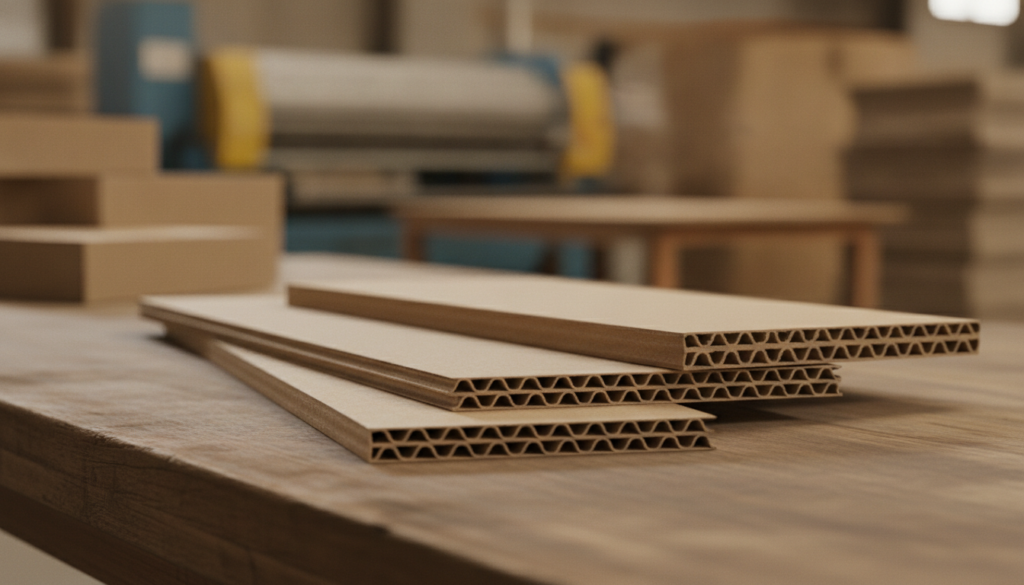
Quick answer: Corrugated box flutes are the wavy inner layer of fluted paper glued between flat liners, and they decide how strong, cushioned and printable your box is. Taller flutes like A and C give you stacking strength and shock absorption for heavier or fragile goods. Shorter flutes like B, E and F give you a smoother surface for sharp retail printing. Match the flute and the wall type to your product weight, transit distance and how good the print needs to look, and you get a box that protects the goods without paying for board you do not need.
Choosing board sounds technical, yet the logic is refreshingly practical once the jargon is stripped away. This guide walks through single, double and triple wall, the common flute profiles, board weight and the two strength tests packaging people actually talk about. By the end you will be able to brief a supplier with confidence, or simply tell us what you are shipping and let our team spec it for you.
What are corrugated box flutes?
A flute is the arched, wavy sheet of paper running through the middle of corrugated board. That fluting is glued between one or more flat sheets called liners, and the arches act like tiny structural columns. They resist crushing from above and springs back against knocks from the side, which is why a lightweight sheet of cardboard can carry surprisingly heavy loads.
The height and spacing of those arches change everything. Bigger flutes trap more air, so they cushion better and add rigidity for stacking. Smaller, tighter flutes create a flatter, denser surface that prints cleanly and folds crisply for retail packaging. Nearly every brown box you have ever received owes its strength to this simple corrugated sandwich.
What is the difference between single, double and triple wall?
The wall type describes how many layers of fluting sit inside the board, and it is the first thing to settle before you worry about flute letters. Single wall has one fluted medium between two liners and handles most everyday shipping and retail work. Double wall stacks two fluted layers between three liners for heavier goods and rough transit. Triple wall uses three fluted layers and is built for industrial loads that might otherwise need a timber crate.
Here is the plain-English version:
- Single wall: the workhorse. Great for e-commerce parcels, retail cartons and general freight up to moderate weights.
- Double wall: noticeably tougher. Suited to heavier products, export shipping, and anything stacked high in a warehouse.
- Triple wall: industrial strength. Machinery parts, bulk components and very heavy or dense goods.
If your current boxes arrive dented or crushed, moving up a wall type is often the quickest fix. For heavier and bulky items we usually point clients toward our bulky goods boxes, which are built on stronger board from the start.
What do the flute profiles A, B, C, E and F mean?
Flute profiles are labelled with letters, and the letters roughly describe height rather than order. The lettering is historical, so they do not run neatly from smallest to largest. Each profile trades cushioning and stacking strength against surface smoothness and print quality, which is exactly why there are so many of them.
The larger flutes: A and C
A-flute is the tallest common profile, with big, widely spaced arches. It delivers the best cushioning and top-to-bottom stacking strength, so it suits fragile or heavy items that need protection in transit. C-flute sits just below it in height and has become the all-round favourite for shipping cartons. It balances cushioning, stacking strength and a reasonable print surface, which is why so many standard shippers use it.
The smaller flutes: B, E and F
B-flute is shorter and more tightly packed, giving a flatter surface, good puncture resistance and crisp die-cutting for product boxes. E-flute is much finer again, thin enough to replace a folding carton while adding real protection, and it prints beautifully for retail. F-flute is finer still and shows up in premium small packaging where a smooth, high-detail print matters most.
Combined profiles like BC and EB
Double wall boards often pair two flute sizes, written as BC or EB. Combining a taller flute for strength with a shorter flute for surface quality gives you cushioning and a printable face in one board. It is a common choice when a heavy product also needs to look good on a shelf.
Which flute is best for printing?
For sharp, full-colour retail printing, the finer flutes win, because a flatter, denser surface holds detail far better than a tall, ribbed one. E-flute and F-flute give the cleanest results and are popular for product boxes, cosmetics, food packaging and anything sold face-out on a shelf. B-flute is the practical middle ground, printing well while still shrugging off knocks.
Taller flutes such as A and C can still be printed, though very fine text or photographic images may show faint washboarding, where the flute lines telegraph through the liner. If you need premium graphics on a strong shipper, a combined double wall board or a laminated printed liner solves it. Our full-colour digital and offset printing runs across all of these boards in house, so we can match the flute to the artwork rather than compromising one for the other. Browse ready options in the shop or send us your design.
How do board weight and GSM affect strength?
Board weight is measured in GSM, or grams per square metre, and it describes how heavy the paper in each liner and medium is. Heavier liners generally mean a stronger, more rigid board that resists punctures and holds print better. It is not the only factor, since flute profile and wall type matter just as much, yet GSM is a useful shorthand when comparing two similar boards.
The liner also comes in different papers. Kraft liners use fresh long-fibre pulp for higher strength and a clean printing face, while test and recycled liners keep cost and environmental impact down. All of the corrugated we run is 100% recyclable, and much of it carries recycled content, so choosing an eco-friendly board rarely means giving up performance. The right combination of GSM, liner type and flute is where a manufacturer earns its keep.
What do edge crush and bursting strength mean?
Two tests describe corrugated strength in the real world, and understanding them saves you a lot of guesswork. Edge Crush Test, or ECT, measures how much compression the board withstands on its edge, which predicts stacking strength. If your cartons sit on pallets stacked several high, ECT is the number that keeps the bottom box from collapsing.
Bursting strength, often called the Mullen or burst test, measures resistance to a puncture or a sudden blow, so it reflects rough handling and rowdy freight networks. Neither test is better than the other. Stackable warehouse stock leans on ECT, while single parcels bouncing through couriers lean on burst resistance. When you tell us how the box travels and stores, we translate that into the right board specification without burying you in numbers.
How do I choose the right board for my product?
Start with three questions: how heavy is the product, how far and how roughly does it travel, and how good does the print need to look. Weight and stacking push you toward taller flutes and double wall. Long or rough transit pushes you toward higher strength and burst resistance. Premium retail print pulls you toward the finer flutes.
A quick rule of thumb we use with clients:
- Light retail or subscription items, shelf appeal matters: single wall E-flute or B-flute.
- General e-commerce parcels: single wall B or C-flute.
- Heavier, fragile or export goods: double wall BC, or a bulky goods board.
- Very heavy or industrial loads: triple wall.
Most everyday shipping is well served by a solid single wall carton, and our standard boxes cover that ground. When you are unsure, it is far cheaper to ask before you print a run than to discover a weakness after the first delivery arrives crushed.
Why the right board is easier with a local manufacturer
We make our boxes here in Australia in our own factory, so we are not a reseller reading a catalogue back to you. That means fast local turnaround, full-colour digital and offset printing in house, eco-friendly 100% recyclable board, and no minimum order quantity, whether you need fifty boxes or fifty thousand. Because we control the board and the press, we can spec the exact flute, wall and GSM your product needs rather than pushing you toward whatever is on the shelf.
Not sure which board fits your product? Tell us what you are shipping and we will recommend the flute and grade as part of a free, no-obligation quote. Explore the full box range or get a quote and our team will handle the technical side.
Frequently asked questions
Sources and references: Australian and international corrugated packaging conventions for flute profiles, board grades and strength testing (Edge Crush Test and bursting strength), combined with Custom Boxes Australia’s own manufacturing and printing experience. Specific flute dimensions and strength values vary by supplier and specification, so we describe them qualitatively and confirm exact figures on quote.