
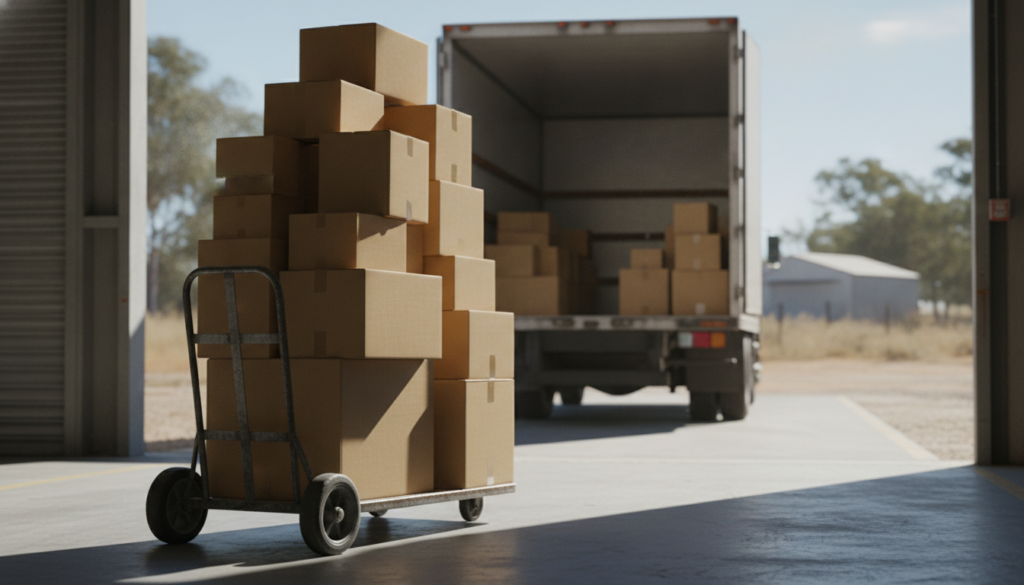
Custom shipping boxes cut your costs in two places at once. A box sized to fit the product removes the empty space that couriers charge you for through dimensional weight, and the right board and inserts stop the knocks that turn a delivery into a return. Off-the-shelf cartons rarely match your product closely enough to do both, which is why a made-to-measure box usually pays for itself across a shipping season.
This guide breaks down where the money leaks, how to choose board and format by what you actually send, and how to trial the right size without committing to a huge run.
How do custom shipping boxes cut freight cost and damage?
Freight and damage are the two biggest hidden costs in shipping, and both trace back to the box. Australian couriers price parcels on whichever is greater, the actual weight or the cubic (dimensional) weight, so a light product in an oversized carton gets billed as if it were heavy. Damage adds a second bill in returns, replacements and lost repeat custom. A box built to fit attacks both problems together.
The saving is not theoretical. Every centimetre of dead space inside a carton is air you are paying to move, and every millimetre of loose room lets contents shift and take impact. Right-size the box and you shrink the cubic weight while removing the movement that breaks fragile goods. That is the whole case for a custom shipping box in one sentence.
What is dimensional weight and why does it inflate your bill?
Dimensional weight is a pricing method that charges for the space a parcel occupies, not just its mass. Most Australian carriers calculate cubic weight by multiplying length by width by height in metres, then applying a conversion factor (a divisor of around 250 is common, though each carrier sets its own). If that cubic figure beats the scale weight, you pay on the cubic figure. Always confirm the exact formula with your own courier.
Here is why it stings. A pair of trainers in a carton twice the size it needs might weigh under a kilogram on the scales, yet bill as three or four kilograms on cube. Multiply that gap across a month of orders and the overspend is real money. Shaving even a few centimetres off each dimension can drop a parcel into a lower price bracket, which is the fastest packaging win most shippers never take.
How does right-sizing a box cut dimensional-weight charges?
Right-sizing means building the internal dimensions to hug the product with only the clearance it needs for protection. When the box footprint drops, the cubic weight drops with it, and so does the amount of void fill you buy to stop rattle. You spend less on the box, less on the courier and less on padding, all from one decision made at the design stage.
Standard cartons force a compromise, because you pick the nearest size up and pay for the gap. A custom box removes that gap. If you ship a few core products in steady volumes, a purpose-made size for each one tends to return the setup cost quickly. Because we manufacture with no minimum order, you can order a modest batch of a new size, weigh the real parcels, and confirm the cube saving before scaling the run.
Which board and inserts stop transit damage and returns?
Board strength is what stands between your product and the courier network. Corrugated board comes in different flute profiles and wall counts, and the heavier grades resist crushing and stacking pressure far better. Single-wall board suits apparel, homewares and light goods, while double-wall board earns its place for heavy, dense or fragile items that face a long trip and a few rough handovers on the way.
Inserts do the other half of the job. A snug box stops big movement, and a fitted insert stops the small shifts that chip, scratch or crack a product in transit. Die-cut cardboard inserts, pads and dividers hold each item in its own pocket so nothing knocks against its neighbour. Getting board and inserts right together is usually cheaper than absorbing the returns, refunds and replacement freight that weak packaging invites.
Not sure which grade your product needs? Request a free quote with your item weight and dimensions, and we will spec the board and inserts for you.
Which shipping box should you use for what you send?
Match the format to the job and both cost and protection fall into line. The four everyday choices are mailers, standard shippers, bulky-goods boxes and pallet boxes, and each suits a different weight, size and handling profile. Choosing by what you actually send, rather than by what happens to be in the cupboard, is the simplest way to stop overpaying on freight.
Mailers for light, flat and low-risk goods
A self-locking mailer is the economical pick for apparel, books, cosmetics and small e-commerce orders. It uses less board, folds flat for storage and keeps the parcel slim, which helps on cube. Full-colour printing turns a plain mailer into a branded unboxing moment without adding meaningful weight or freight cost.
Standard shippers for everyday parcels
A regular slotted carton is the workhorse for mixed orders, fulfilment and transit. It stacks well, seals fast and comes in single or double wall depending on the load. For steady product lines, a custom-sized shipper trims the void space that standard cartons leave behind.
Bulky-goods boxes for large or heavy items
Oversized and heavy products need a box engineered for the load. Our bulky-goods boxes use stronger board and structural design to carry weight and survive handling that would flatten a light carton. Sizing them to the product still matters, because bulky items rack up cubic weight quickly.
Pallet boxes for freight and bulk movement
When you ship in volume or move stock between sites, a pallet box consolidates many units into one stable, forkliftable load. It protects goods through warehouse handling and cuts the per-item freight cost compared with many small parcels. This is the format for wholesale, distribution and interstate bulk runs.
How should you pack fragile and heavy items?
Fragile and heavy goods fail in transit for two different reasons, so they need two different fixes. Fragile items break from shock and vibration, so they want a snug box, a fitted insert and enough clearance on every face to absorb a knock. Heavy items fail from board collapse and burst seams, so they want a higher board grade, reinforced construction and a size that keeps the load stable rather than sliding.
A few practical habits prevent most claims. Pack to the box edges so contents cannot shift, keep the heaviest items low and central, and never reuse a tired carton whose flutes have already been crushed once. For anything genuinely delicate, pair a double-wall box with a die-cut insert so each piece travels in its own seat. The extra cents per parcel are far cheaper than the refund, the replacement and the disappointed customer who does not order again.
Why do custom-sized boxes beat off-the-shelf cartons?
Off-the-shelf cartons look cheaper on the shelf and cost more in the parcel. Because they come in fixed jumps, you round up to the nearest size and pay the difference in cubic weight, void fill and damage risk on every single order. A custom box removes that recurring tax by fitting the product from the first unit, which is where the real saving lives.
There is a trial cost to a new custom size, and this is exactly where no minimum order changes the maths. You can order a small run of a right-sized box, ship real orders through it, and measure the drop in cube and damage before committing to volume. Made locally in Australia on our own presses, with eco-friendly board that is 100% recyclable, the sample turnaround stays short and you keep testing sizes until the numbers are as tight as they can be. Browse formats in the shop to see the range.
Why order from an Australian manufacturer, not a reseller
Buying direct from the factory keeps the price honest and the lead time short. As a local Australian manufacturer running our own production, we print full colour on digital and offset presses, work with recyclable board, and set no minimum order so you can begin at any scale. There is no reseller margin stacked on top, and no long import wait that leaves you short of stock in a busy week.