
The paradigm of global logistics is currently experiencing a profound metamorphosis.
Driven by the dual pressures of economic optimization and the escalating demand for environmental accountability, supply chains are growing more complex.
In this context, understanding core honeycomb box benefits is essential for businesses looking to protect their goods and reduce overhead costs.
As a disruptive innovation, honeycomb boxes bridge the gap between the structural rigidity of traditional timber and the cost-effective flexibility of corrugated cardboard.
This comprehensive guide provides an exhaustive analysis of honeycomb technology, detailing its strategic advantages in B2B and e-commerce sectors, its comparative performance against legacy materials, and its role as a cornerstone of the burgeoning circular economy.
Exploring Honeycomb Box Benefits in Sustainable Logistics
Sustainability has transitioned from a Corporate Social Responsibility (CSR) initiative to a fundamental requirement for global market participation.
One of the primary honeycomb box benefits is its compelling ecological advantage, offering a renewable and recyclable alternative to plastic foams.
Eco-Friendly Material Sourcing and Composition
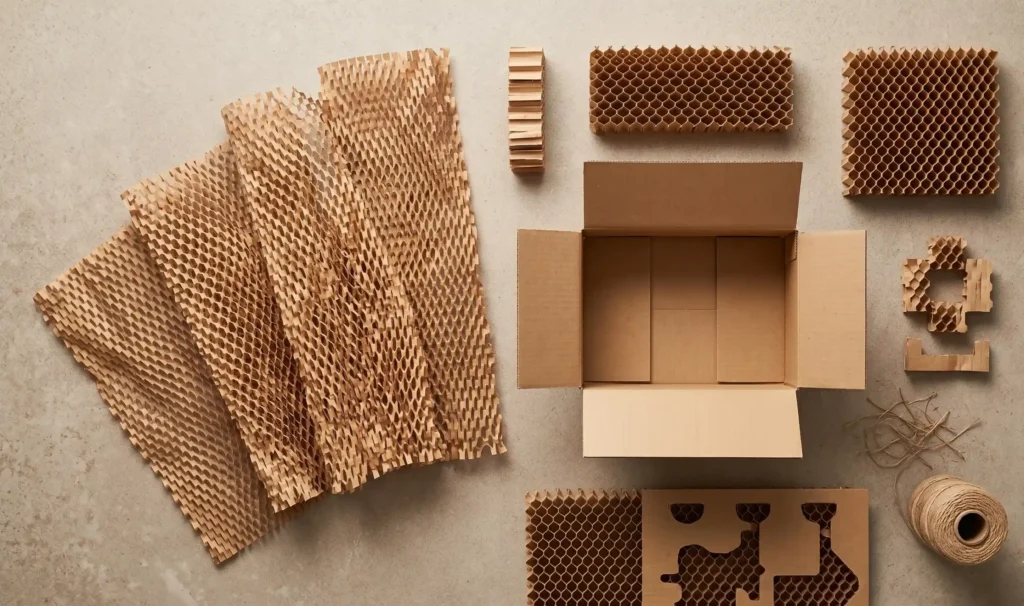
The efficacy of honeycomb packaging is rooted in biomimicry replicating the hexagonal structures found in natural beehives.
This geometric configuration provides the maximum amount of structural support with the minimum amount of raw material.
Typically constructed from recycled Kraft paper and bonded with non-toxic, water-based adhesives, these boards align perfectly with the APCO National Packaging Targets for sustainable design.
Maximizing Recyclability and Biodegradation Over Plastic Foams
When compared to Expanded Polystyrene (EPS) the traditional choice for protective inserts honeycomb’s lifecycle is vastly superior.
EPS is derived from non-renewable fossil fuels and persists in landfills for centuries.
Honeycomb is 100% recyclable in standard commercial paper streams and can be repulped into new cardboard products rapidly, supporting a closed-loop system.
Reducing Your Carbon Footprint Through Lightweight Design
Because the honeycomb core consists of 85% to 95% air by volume, it is exceptionally lightweight.
This weight reduction directly translates to lower fuel consumption during transport.
A lighter payload means fewer greenhouse gas emissions per shipment, allowing businesses to actively shrink their carbon footprint while maintaining robust product protection.
Structural Performance and Protection
The mechanical foundation of honeycomb sets it apart from traditional corrugated options, making it ideal for the rigors of modern fulfillment.
Unmatched Shock Absorption and Load Distribution
While standard corrugated cardboard is anisotropic (strength is concentrated along parallel flutes), honeycomb distributes force laterally across a network of interconnected cell walls.
When subjected to impacts or drops, the cells systematically deform, acting as a superior buffer that progressively dissipates shock energy.
In testing based on ASTM D4169 standards, honeycomb absorbs up to 60% more shock energy than standard corrugated board.
Durable Performance for Fragile and Heavy Goods
Honeycomb boasts exceptional compressive strength, reaching stacking strengths of up to 800 kPa.
It is highly resistant to “creep” the gradual deformation of boxes at the bottom of a heavy stack in a warehouse.
Its flat crush resistance makes it the premier choice for protecting heavy machinery parts or acting as inter-layer protection for rigid items.
Addressing Technical Needs: Anti-Static and ESD Options
A critical requirement for shipping electronics is protection against Electrostatic Discharge (ESD), which can destroy sensitive components.
While standard paper can generate static, premium honeycomb suppliers can apply specialized Anti-Static (AS) and ESD-protective coatings directly to the facings, ensuring strict electrical safety compliance.
Honeycomb Box Benefits for E-commerce Success
In online retail, packaging is both a logistical hurdle and a vital brand touchpoint.
When evaluating honeycomb box benefits, enhancing the customer experience is just as important as reducing freight costs.
Enhancing the Customer Unboxing Experience and Brand Loyalty
The e-commerce “last mile” ends in the customer’s hands.
Traditional void fill like messy packing peanuts frustrates consumers.
Using precision die-cut honeycomb inserts offers a clean, premium aesthetic.
This geometric layout signals craftsmanship and environmental responsibility, elevating the unboxing experience and driving brand loyalty.
Protecting High-Value Items: Electronics, Glassware, and Art
For fragile-heavy categories, internal movement causes the most damage.
Custom honeycomb inserts can be engineered to precisely cradle luxury cosmetics, electronics, or framed artwork.
By locking the product in place, retailers see sharp reductions in breakage rates and costly returns.
Optimizing Dimensions for Major Shipping Carriers
Major carriers utilize Dimensional (DIM) Weight pricing, charging based on package volume.
Honeycomb’s superior strength-to-weight ratio allows brands to use thinner protective walls compared to bulky EPS foam.
This enables businesses to “right-size” their boxes, shrinking external dimensions and saving thousands in annual freight costs.
B2B and Industrial Applications
Beyond small parcels, honeycomb is revolutionizing heavy-duty industrial logistics.
Heavy-Duty Load Stabilization for Pallets and Machinery
In B2B warehouses, honeycomb is frequently utilized as heavy-duty layer pads and top boards.
Its rigidity stabilizes loads far better than standard corrugated sheets.
Businesses utilize honeycomb totes to securely transport industrial components between manufacturing facilities.
Compliance and Certifications: Fire Resistance and International Shipping
Industrial applications often require strict safety compliance.
Honeycomb packaging can be treated to meet specific fire retardancy certifications required for aerospace, automotive, and military supply chains.
Replacing Traditional Wooden Crates and Pallets (ISPM 15)
Wood is heavy, prone to splintering, and subject to ISPM 15 regulations, mandating costly heat treatment for export.
Honeycomb pallet boxes are up to 75% lighter than timber and naturally exempt from ISPM 15.
This eliminates customs delays and fumigation costs, creating a frictionless export experience.
Operational Efficiency and Cost Management
The true value of honeycomb packaging is realized in warehouse efficiency.
Comparing Costs: Honeycomb Tooling vs. Polystyrene Molds
Custom packaging often incurs high upfront costs.
However, the die-cutting and tooling processes for honeycomb are significantly cheaper and faster than creating steel molds for polystyrene (EPS) foam.
This makes custom honeycomb inserts financially viable even for smaller production runs.
Automation and Integration into Modern Fulfillment Centers
Unlike unpredictable wooden pallets, honeycomb boards offer consistent geometry.
They integrate seamlessly with automated palletizing robots and conveyor belts, allowing facilities to maintain high throughput without equipment jams.
Concrete ROI: Case Studies on Damage Reduction and Freight Savings
Replacing a 20kg wooden export crate with a 5kg honeycomb equivalent saves 15kg per shipment.
At standard airfreight rates, a B2B supplier shipping volume goods saves exponentially on freight alone, not including the labor saved by using a material easily handled by a single worker.
Customization and Implementation Process
Transitioning to honeycomb is a highly collaborative engineering process.
Understanding the Custom Design, Die-Cutting, and Lead Time
Partnering with a supplier involves designing inserts tailored to your exact product dimensions using 3D CAD software.
Because tooling is less complex than foam molding, prototyping is rapid and production lead times are short.
Choosing the Right Thickness and Facing for Your Product
Buyers can specify cell size, core thickness (ranging from 10mm to over 100mm), and facing materials (like moisture-resistant Kraft or white printable liners).
This ensures the packaging is perfectly calibrated.
Conclusion: Packaging Smarter, Greener, and Lighter
To fully leverage honeycomb box benefits, businesses must align mechanical performance, economic efficiency, and environmental responsibility.
For B2B enterprises, it resolves the regulatory and weight burdens of timber.
For e-commerce operators, it optimizes shipping costs while delivering a premium unboxing experience.
To start your transition, get a quote today or explore our full range of solutions in our online shop.
Frequently Asked Questions
Is honeycomb packaging suitable for use in automated e-commerce packing systems?
Yes, honeycomb packaging materials can be easily integrated into automated packing lines due to their standardized formats, flat-packing design, and versatility, helping businesses with high shipping volumes maintain efficiency.
How much lighter is honeycomb packaging compared to wooden crates or pallets?
Honeycomb pallets and crates are up to 75% lighter than their wooden counterparts.
This weight reduction significantly lowers transportation expenses and fuel consumption.
Can honeycomb packaging materials provide anti-static (ESD) protection for electronics?
While the core material is paper, honeycomb suppliers can apply specialized anti-static or ESD-protective coatings to the facings, making the packaging safe for shipping sensitive electronic components.
Is honeycomb packaging 100% recyclable, and how do consumers dispose of it?
Honeycomb packaging made from kraft paper and water-based adhesives is 100% recyclable.
Consumers can easily dispose of it in standard paper recycling bins, drastically reducing landfill waste.
Is the tooling required for custom honeycomb inserts expensive for B2B applications?
The tooling used for cutting honeycomb is significantly less expensive than the molds required for producing alternative materials like polystyrene wedges.
This low tooling cost makes honeycomb a viable option even for small production runs.
What makes honeycomb structures so strong and protective during transit?
The strength comes from the interlocking hexagonal cell design, which mimics a beehive structure.
This geometric design effectively spreads tension and compression forces, acting as a superior buffer to absorb shocks and vibrations.
Can honeycomb board be printed on for branding purposes?
Yes, the flat facing sheets of honeycomb boards are perfectly suitable for printing logos, brand messaging, and product details, allowing businesses to enhance their brand image and the unboxing experience.
What is the difference between honeycomb packaging and regular corrugated cardboard?
While both are paper-based, honeycomb board features a much denser, hexagonal core structure that distributes pressure more effectively than the fluting in corrugated cardboard.
This gives honeycomb superior compression strength and load-bearing capacity for heavy or delicate items.