
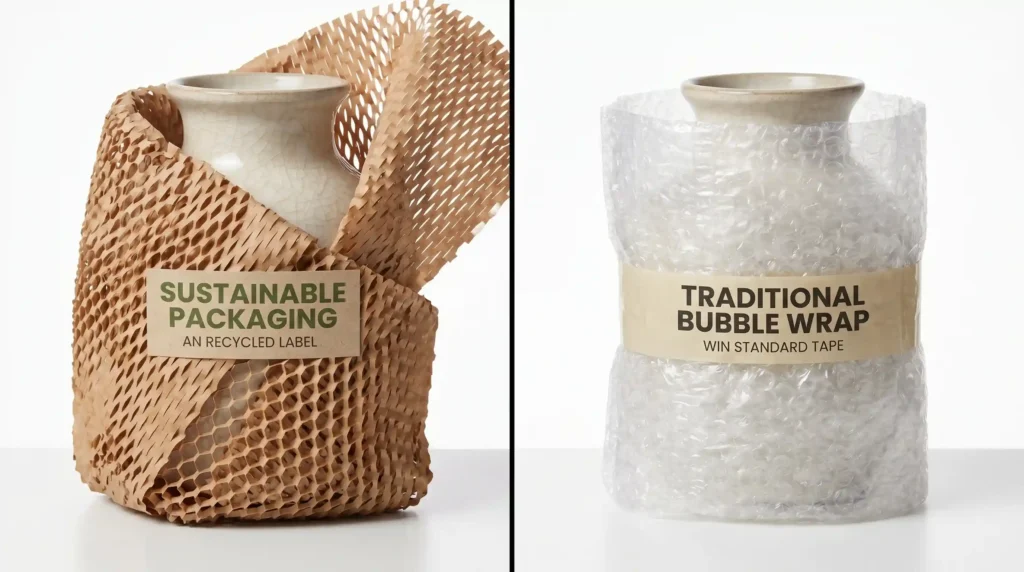
The evolution of global logistics and supply chain management has reached a critical inflection point.
For decades, the industry relied almost exclusively on pneumatic cushioning, characterized by the ubiquity of low-density polyethylene (LDPE) bubble wrap.
However, the choice of protective packaging is no longer just a secondary procurement concern it is a primary operational strategy.
As regulatory pressures mount and warehouse real estate costs soar, a significant market shift is underway.
Traditional plastic based solutions are increasingly being challenged by structural engineering innovations, most notably die-cut kraft paper expanded into a three-dimensional honeycomb matrix.
If you are a logistics manager or e-commerce business owner evaluating honeycomb vs bubble wrap packaging, understanding the technical, economic, and environmental differences between these two systems is essential for optimizing your fulfillment process.
1. Quick Comparison: Honeycomb vs Bubble Wrap at a Glance
Before diving into the deep technical specifications, it helps to view how these two protective packaging materials stack up across core operational metrics.
Key Deciding Factors for Packaging Buyers
When choosing between honeycomb packaging and bubble wrap, procurement teams must balance three critical factors: kinetic energy dissipation, Total Cost of Ownership, and environmental life cycle.
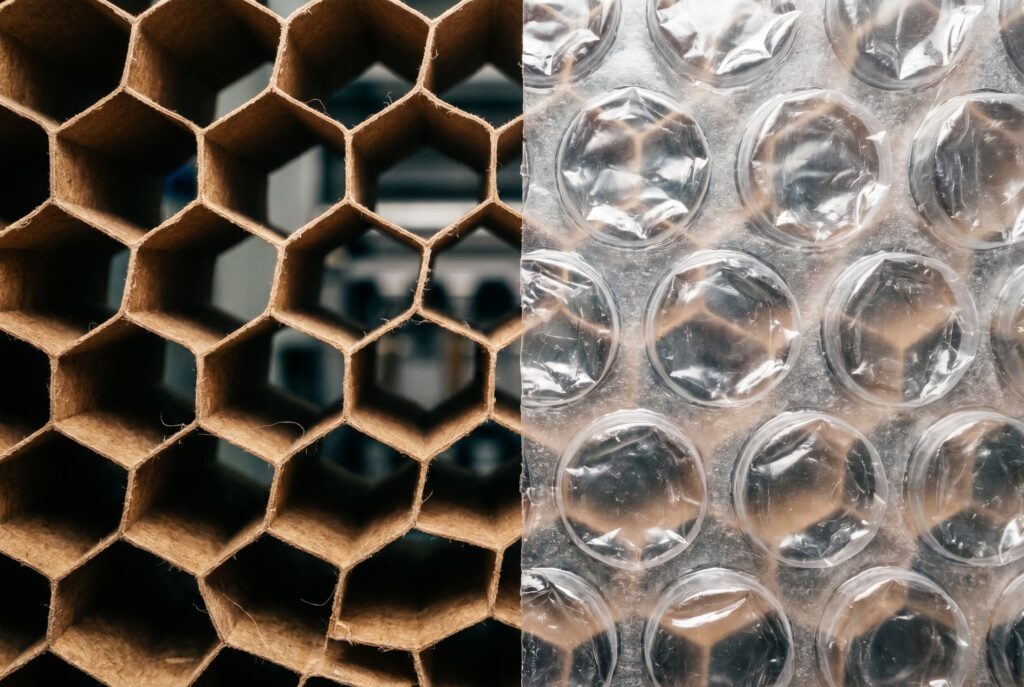
While bubble wrap operates by trapping air, honeycomb packaging relies on structural geometry and material science to disperse impact forces.
When Should You Choose Honeycomb Packaging?
Honeycomb packaging is the optimal choice when your operation demands high-throughput packing speeds, reduced warehouse storage footprints, and superior vertical crush resistance for heavy items.
It is also the definitive choice for brands looking to elevate the customer unboxing experience while eliminating single-use plastics.
2. Durability: Crushing Resistance and Weight Capacity
To quantify protective performance, packaging engineers look beyond the softness of a material and evaluate its ability to decelerate an item during an impact.
Understanding Vertical Strength and Load Bearing
The fundamental vulnerability of bubble wrap is its reliance on air pressure and plastic film integrity.
If an impact force exceeds the tensile strength of the polyethylene film, the cell ruptures.
This bottoming out phenomenon leads to a complete loss of protection at the point of highest stress.
Cardboard honeycomb core operates entirely differently.
Utilizing the structural rigidity of paper fibers and the tension created across its hexagonal walls, honeycomb paper resists deformation up to a compressive strength of 0.5 MPa.
Under ASTM D642 testing standards, honeycomb demonstrates up to 40% higher crush resistance than traditional pneumatic bubble wrap.
Shock Absorption: Protecting Against Drops
Packaging engineers utilize the Cushioning Index to define a material’s ability to reduce the G-force transmitted to a product.
Standard 80 GSM honeycomb paper achieves a Cushioning Index of approximately 1.8 g/cm2, representing a 30% increase in protective strength over high-quality bubble wrap.
More importantly, bubble wrap loses over 60% of its protective capacity after just two impacts.
Honeycomb paper maintains its shape integrity through up to five consecutive drops due to its systematic deformation.
3. Cost-Effectiveness and Logistics
Evaluating packaging materials based solely on the per-meter purchase price is a common error that masks hidden operational expenses.
Material Cost vs Total Cost of Ownership
While the upfront unit cost of honeycomb board might appear higher than bulk bubble wrap, a Total Cost of Ownership framework reveals a different reality.
Honeycomb systems eliminate the need for adhesive tape, significantly increase labor throughput, and eradicate rising plastic disposal tipping fees.
Warehouse Efficiency: Storage and Pack Time
Traditional bubble wrap is incredibly inefficient to store because you are essentially paying to store air.
Honeycomb paper arrives on hyper-condensed rolls or as flat-packed boards.
A single pallet of un-expanded honeycomb paper is equivalent to nearly an entire truckload of pre-inflated plastic bubble wrap.
Furthermore, the honeycomb structure is self-locking.
When wrapped around an item, the cells interlock organically, eliminating the need for tape and increasing packing speed by up to 40%.
4. The Environmental Scorecard
The environmental debate between paper and plastic packaging is nuanced, but end-of-life characteristics heavily dictate modern purchasing decisions.
Is Bubble Wrap Recyclable in Australia?
Bubble wrap takes between 500 and 1,000 years to decompose.
While technically recyclable, it falls under the soft plastics category, which is notoriously difficult to process.
Municipal recycling facilities frequently reject bubble wrap because the thin films jam sorting machinery.
The 100% Recyclable Nature of Honeycomb Board
Honeycomb packaging is manufactured from renewable wood pulp and is completely biodegradable.
It fits seamlessly into existing commercial and curbside paper recycling programs.
When businesses transition to honeycomb, they instantly remove massive volumes of permanent plastic waste from their supply chain.
This aligns with the national goals set by the Australian Packaging Covenant Organisation.
5. Best Use Cases and Industry Applications
While performing a honeycomb vs bubble wrap comparison, choosing the right material requires aligning it with your specific product category.
Packaging Artwork and Fragile Items
High-value fragile items require rigid, structural protection.
Bubble wrap can easily slip or deflate around sharp frame corners.
Custom honeycomb inserts can be engineered to precisely cradle artwork, ensuring the piece cannot shift.
This makes it perfect for art logistic shipping.
Custom Sizing for E-commerce Mailer Boxes
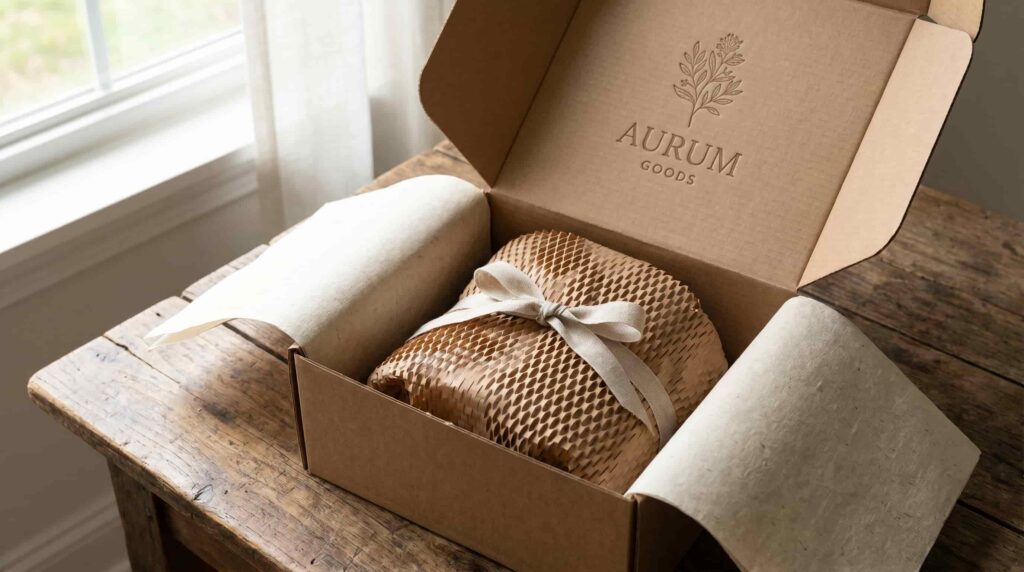
Packaging is the only physical touchpoint between an e-commerce brand and its customer.
Bubble wrap is increasingly perceived as industrial trash.
Conversely, 78% of shoppers rate items wrapped in geometric honeycomb paper as more thoughtful and premium.
Using it inside your custom mailer boxes enhances the unboxing ritual.
6. Next Steps: Ordering Custom Honeycomb Packaging
Transitioning your supply chain away from inefficient plastics requires a reliable manufacturing partner.
Australian-Made Packaging with No Minimum Order
At Custom Boxes Australia, we understand that businesses need access to premium, sustainable packaging.
We proudly offer Australian-made custom honeycomb boxes with absolutely no minimum order quantities.
You can secure the exact amount of packaging you need without tying up capital.
Get a free quote today to optimize your fulfillment process.
Frequently Asked Questions
Is honeycomb cardboard stronger than bubble wrap for heavy-duty shipping?
Yes, honeycomb cardboard provides superior vertical strength and crushing resistance.
This makes it better suited than bubble wrap for heavy-duty or palletized shipping where stacking strength is required.
Is honeycomb packaging cheaper than bubble wrap in bulk?
While the unit cost of honeycomb board may be higher than bulk bubble wrap, it can be more cost-effective overall.
It reduces shipping weight, accelerates pack times, and minimizes product damage claims.
How do the two materials compare in terms of environmental impact?
Honeycomb packaging is generally superior, as it is made of paperboard and is 100% recyclable.
Bubble wrap is plastic and is often difficult or impossible to recycle curbside.
Which material is better for protecting high-value fragile items like art?
Custom honeycomb boxes and inserts are often preferred for high-value fragile items.
They offer rigid, structural protection and precise, custom sizing that bubble wrap cannot match.
Can honeycomb inserts replace bubble wrap entirely?
Yes, honeycomb inserts are highly effective replacements for bubble wrap.
They work exceptionally well as void fill or cushioning pads, offering superior structural rigidity and eco-friendliness.
Does bubble wrap or honeycomb take up less storage space in a warehouse?
Honeycomb board is typically shipped flat-packed or on hyper-condensed rolls, maximizing space efficiency.
Bubble wrap consumes significantly more volumetric storage space due to its inflated air cells.
Is honeycomb cardboard fire or water-resistant?
Standard honeycomb cardboard is generally not fire-resistant and has limited water resistance, though specialty coatings can be applied.
Bubble wrap offers no fire resistance and is inherently water-resistant.
Can I order custom-sized honeycomb packaging with no minimum quantity?
Yes, Custom Boxes Australia offers Australian-made honeycomb boxes and inserts with no minimum order quantity.
This allows small businesses to order custom packaging tailored to their exact specifications.