
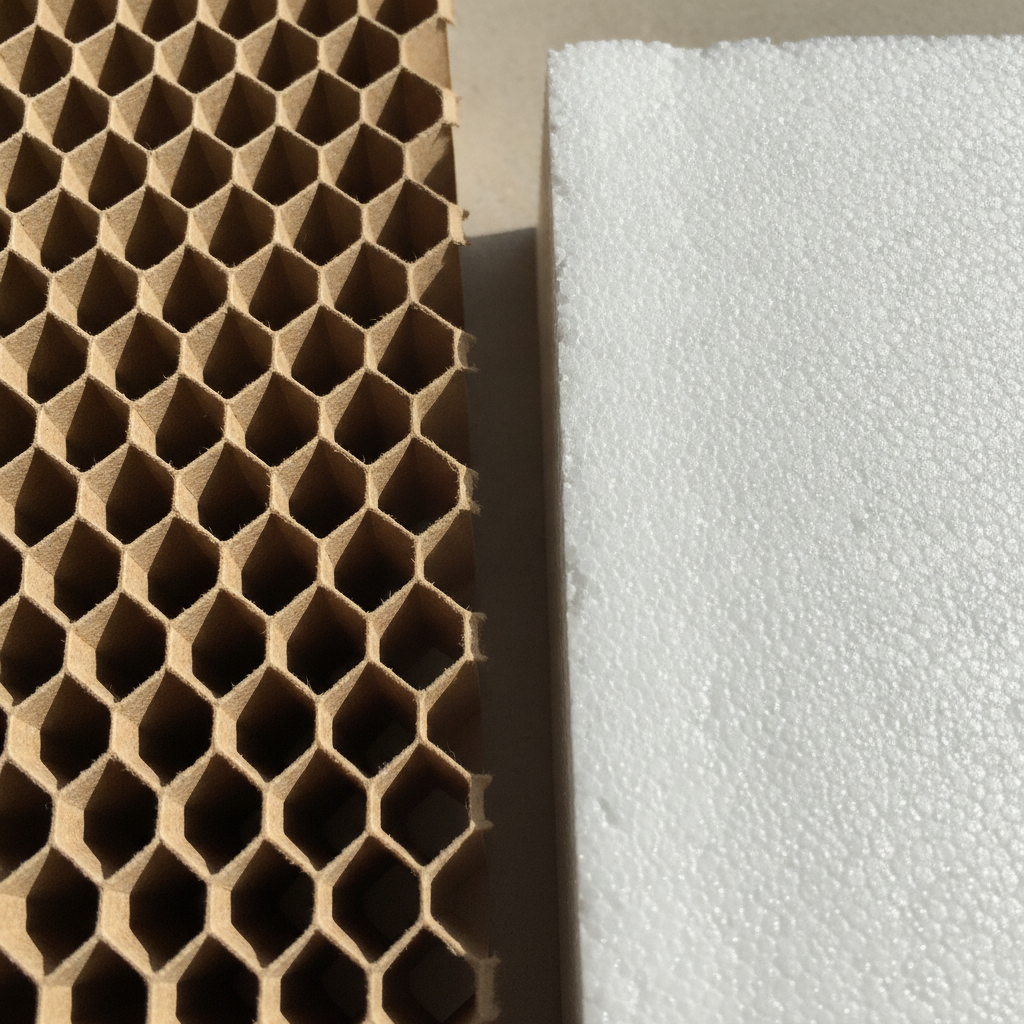
For most protective packaging jobs, honeycomb now matches or beats foam on protection while being far easier to recycle. Foam still wins on soft, conforming cushioning for irregular shapes, but it carries a recyclability and disposal problem that has pushed many Australian businesses to switch. Here is how the two compare and when each one wins.
Key takeaways
- Honeycomb is rigid, structural protection; foam is soft, conforming cushioning.
- Honeycomb is 100% paper-based and kerbside-recyclable; most protective foam is not.
- For heavy, flat or stackable loads, honeycomb wins. For tiny, oddly shaped fragile items, foam still has a niche.
- Honeycomb is custom-cut with no minimum order, so you can switch one line at a time.
Honeycomb vs foam at a glance
| Factor | Honeycomb | Foam |
|---|---|---|
| Protection type | Rigid, structural, compression | Soft, conforming cushioning |
| Strength-to-weight | High | Low |
| Recyclable | Yes (100% paper) | Usually no |
| Disposal | Kerbside recycling | Landfill / special streams |
| Custom shaping | Cut and scored to fit | Moulded (tooling cost) |
| Low-volume cost | Low (no MOQ) | High (tooling) |
| Brand/eco perception | Positive | Increasingly negative |
When does honeycomb win?
- Heavy goods: honeycomb carries industrial loads that crush foam.
- Flat or stackable items: rigid panels brace and stack better.
- Sustainability-led brands: a recyclable, paper-based pack avoids the foam disposal problem.
- Art and fragile high-value goods: rigid bracing with honeycomb inserts protects edges and corners; our art logistic boxes use this approach.
When does foam still have a place?
Foam’s advantage is soft, conforming contact for small, intricate, scratch-sensitive items where a moulded cavity cradles each piece. If you ship high volumes of one small fragile shape and recyclability is not a constraint, moulded foam can still suit. For almost everything else, custom-cut honeycomb provides equivalent or better protection without the waste.
The sustainability difference
The biggest practical divide is end-of-life. Honeycomb goes in the kerbside recycling bin; most protective foam goes to landfill or needs special handling. For brands aligning with Australian recycling expectations and avoiding vague “eco” claims, switching foam to honeycomb is a concrete, defensible improvement, not a marketing line.
How to switch from foam to honeycomb
- Identify your most damage-prone or highest-volume foam-protected line.
- Send us the product dimensions and weight.
- We design a custom-cut honeycomb insert or box and quote in 24 hours.
- Prototype a single unit (no minimum order), test it on a real shipment, then scale.